
The Sky, Reimagined: United Brings the Couch to Economy Class
A new era of long-haul comfort takes flight as United Airlines introduces the Relax Row — the first economy seat in North America that transforms, mid-journey, into something altogether more civilized.
By Tim Robertson – March 25, 2026
United Airlines
For as long as commercial aviation has existed, the economy cabin has been a study in stoic endurance — a test of one’s patience measured in hours, degrees of recline, and the precise angle at which a lumbar pillow ceases to offer any solace at all. United Airlines, it would appear, has finally tired of this arrangement.
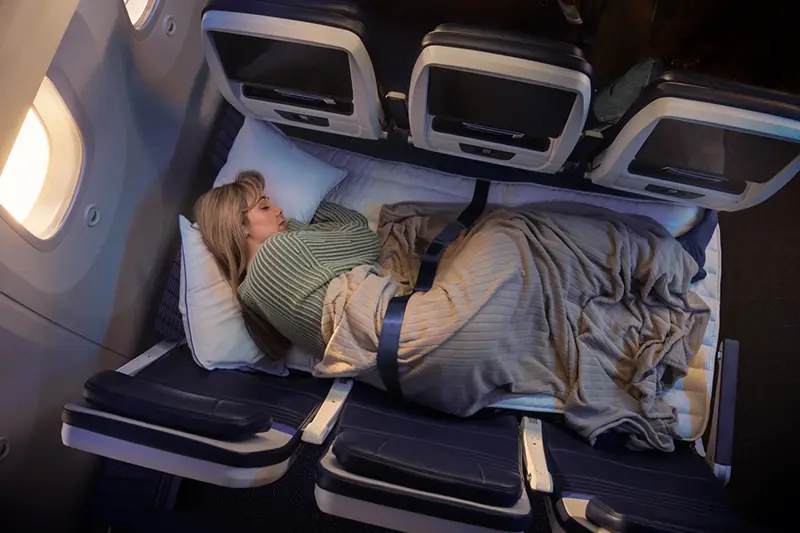
Announced on March 24, 2026, at a high-profile media event in Los Angeles, the United Relax Row is exactly what its name promises: a dedicated row of three economy seats engineered to convert, with elegant mechanical simplicity, into a lounge-like couch. It is a concept that has quietly existed on select international carriers for years, but one that has, until now, remained entirely absent from any North American airline. United intends to change that — and it has secured the exclusive rights to the design within the continent to ensure it does so alone.
A North American First
United did not merely stumble upon this idea. The airline has been steadily refashioning its identity as a premium carrier, and the Relax Row is the latest chapter in that ongoing editorial. As Andrew Nocella, United’s Executive Vice President and Chief Commercial Officer, stated at the announcement: customers flying economy on long-haul routes deserve an option for genuine space and comfort — and this is precisely that option delivered.
The airline confirmed it is the first North American carrier to offer such a product and holds an exclusive on the design within the region. For the discerning traveler who has long looked enviously toward the front of the cabin, this is a meaningful development — not a gimmick, but a considered repositioning of what economy might mean on a twelve-hour flight across the Atlantic or Pacific.

“Customers traveling in United Economy on long-haul flights deserve an option for more space and comfort — and this is one way we can deliver that for them.”
The Mechanics of Comfort
The Relax Row is deceptively simple in its engineering. At first glance, the three seats appear indistinguishable from standard economy — a reassurance, perhaps, that the concept does not require architectural sacrifice. The distinction lies beneath: each seat is fitted with individually adjustable leg rests that fold upward at a precise ninety-degree angle, meeting the seat cushion to create a continuous, flat surface. The effect is, in essence, a sofa suspended at altitude.
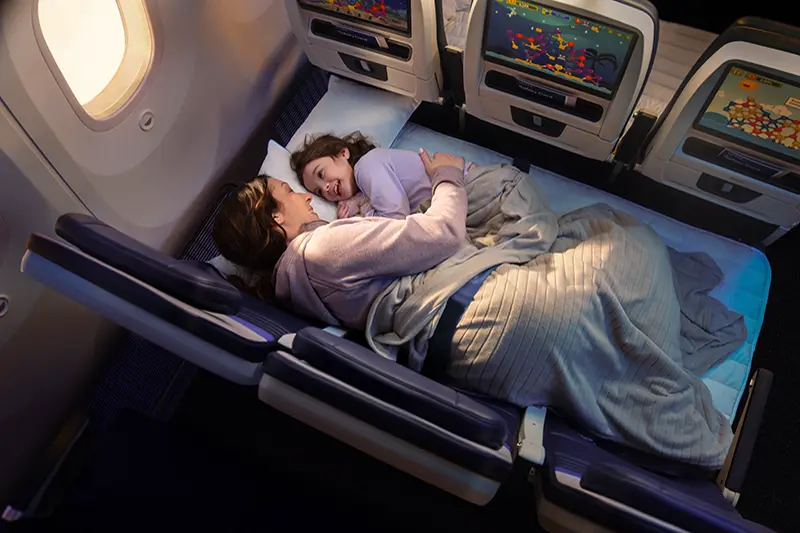
What sets the execution apart from mere mechanical novelty is the accompanying amenity kit. Each Relax Row booking will come with a custom-fitted mattress pad tailored to the dimensions of the transformed row, specially sized blankets, two additional pillows, and — a thoughtful touch — a plush stuffed animal and children’s travel kit for families making the journey with little ones in tow. It is a suite of comforts modest enough not to overstate the product’s promise, yet considered enough to make the difference between merely surviving a red-eye and actually arriving refreshed.
Where It Lives on the Plane
The Relax Row will occupy a thoughtfully chosen position aboard the aircraft: nestled between the United Economy cabin and the brand’s United Premium Plus section. This placement is not incidental. It creates a new tier of experience — a bridge product for travelers who want measurably more comfort than a standard seat but are not yet ready to commit to the Premium Plus fare. In this way, it expands the vocabulary of economy without diluting it.
Up to twelve Relax Row sections will be available on each eligible aircraft, with the airline noting that the average number at full rollout will be approximately nine rows per plane. Scarcity, whether intended or not, lends the product a degree of desirability: booking a Relax Row will require forethought, and perhaps a certain satisfaction in having secured something most fellow passengers will not.
A Global Precedent, an American Debut
For seasoned long-haul travelers, the concept will carry a faint ring of familiarity. Air New Zealand’s Skycouch — a beloved fixture on its transpacific routes — pioneered the convertible economy row model and has, for years, offered a similar sense of horizontal liberation to those willing to pay the premium. Japan’s All Nippon Airways pursued a comparable innovation with its Couchii product. United’s Relax Row draws unmistakable inspiration from these predecessors, yet it brings the concept to a carrier that operates what is now, by available seat miles, the largest airline in the world — and to a continent where nothing of its kind has ever been offered before.
The Relax Row will debut in 2027 on United’s widebody Boeing 787 and 777 aircraft — long-haul workhorses that serve the transatlantic and transpacific routes where comfort is not merely appreciated, but genuinely transformative. By 2030, the airline intends to have the product installed across more than 200 aircraft in its fleet, a rollout that speaks to the seriousness with which United is treating this initiative.
Who It Is For
Credit : United Airlines
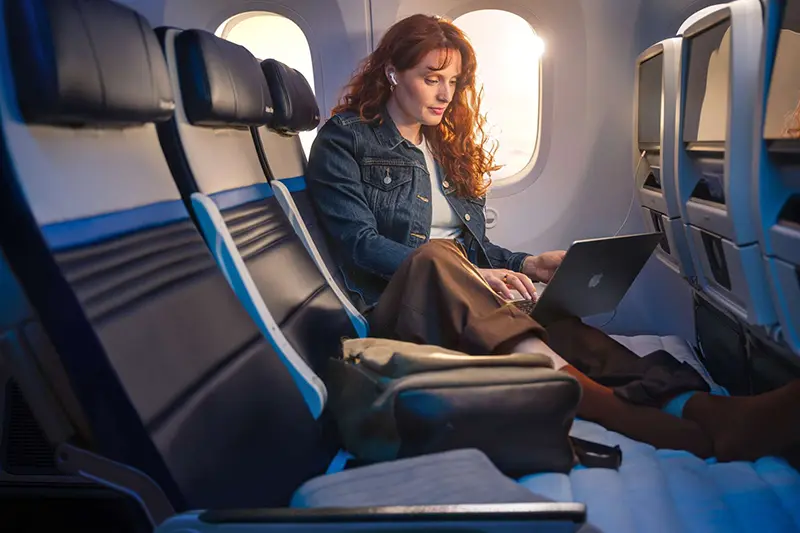
United has been deliberate in articulating its target traveler: families with young children who might curl up together across the row; couples seeking the luxury of shared horizontal space without the obligation of a business class budget; and the solo traveler — perhaps the most interesting figure in this matrix — who chooses to book an entire three-seat row as a private reclining suite. Each archetype is well served by a product that is, at its core, about reclaiming the dignity of rest in a cabin not historically designed to offer it.
Pricing has not yet been announced, and United has indicated that further booking details will be released closer to the 2027 launch. What can be anticipated — if precedents set by Air New Zealand and ANA are any guide — is a model in which the row can be reserved as an add-on to economy fares, with the per-person cost varying depending on how many seats within the row are being purchased. A couple sharing a row will likely pay less per head than a solo traveler commandeering all three. It is a pricing architecture that rewards flexibility and rewards those who plan ahead.
A New Chapter in the Economy Narrative
United Airlines
There is something quietly significant about this moment. The Relax Row does not pretend to be business class. It makes no claims it cannot keep. What it offers instead is something perhaps more rare in commercial aviation: an honest acknowledgment that the long-haul economy experience could be better, paired with a genuine — and genuinely exclusive — solution.
For too long, the conversation around airline innovation has been dominated by ever-more-elaborate business and first-class suites — the kind of offerings that make for spectacular photography but that most passengers will never encounter in the course of ordinary travel. The Relax Row redirects that conversation. It suggests that the future of aviation experience is not only about the sharpest champagne and the most cerulean evening pajamas, but about rethinking what it means to arrive — at your destination, and perhaps at a new standard — feeling like a human being.
United, for its part, appears to understand the weight of that promise. The Relax Row launches in 2027. The anticipation, one suspects, begins now.

TIM ROBERTSON
Robertson is an age-group triathlete based in San Diego and is a national contributor for AWE specializing in culture and travel.